
Story Structure Part 2

Updated: Jun 17

Plotting Definitions for Novels
Story structures for novels have largely been adapted from the pure story telling structures of film. But there are differences in the way scripts and novels are organised so it can sometimes be difficult to figure out how to adapt one to the other.
When working with story structure, you begin at the highest level with the 3 (or 5) act structure which is devolved into story points or plotline elements. These are the points in the story structure framework such as inciting incident, pinch point 1, mid point, climax etc. the number of these points is dependent on the method and structure you have chosen to follow.
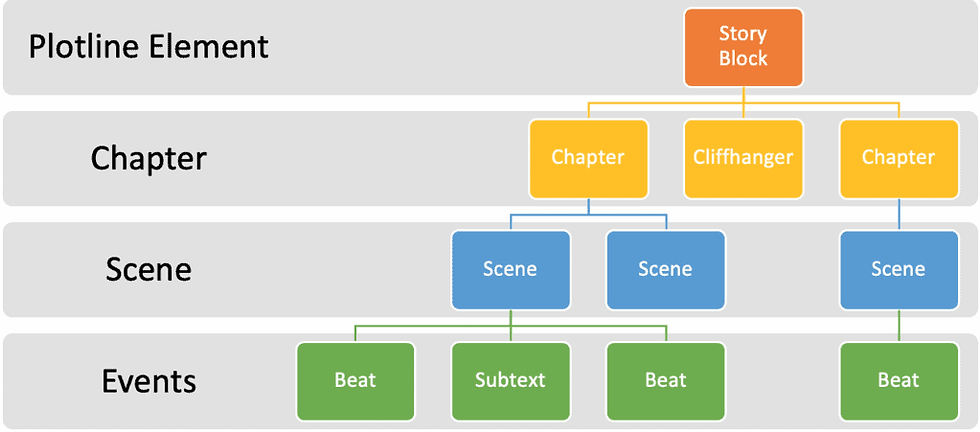
The next level of detail is the story threads, plotlines or story arcs. These are devolved into story blocks or chunks of story. These are then further devolved down to beats, or events that make up a story block. Tied into the action of the story block will be the behaviour and attitude of the character(s), these track the emotional story arc of the character, otherwise known as their change arc. These can be recorded as subtext, a kind of beat that doesn’t stand alone, but which captures the essence of the characters reaction to the beats (events) exhibited in their actions (beats).This all makes perfect sense, but what happens when you try to translate this into a writing app that splits everything into chapters and scenes? How do they fit? One way to think of the Chapters and Scenes is as fitting in between the story blocks and beats. But this isn’t the only way to think about chapters and story blocks. A story block may span several chapters, conversely it might be contained within one chapter.
A chapter may contain parts of several story blocks belonging to different story threads. It is quite fluid so you need to think about them as being less hierarchical. This is why novelists tend not to split their novels up into chapters until later. Chapters are less important than scenes. Scenes tend more often to have a one to one relationship with beats. But a scene may contain more than one beat if it is tying up more than one story thread. Scenes will contain subtext too.

Here are some definitions to help
Plotline: a character arc or story thread that makes up the whole plot
Plotline Elements: structural elements of the plot, eg: Inciting Incident, Black moment etc.
Story Block: a coherent chunk of story that may be spread over one or more chapters, usually related to a structural element and plotline or story arc. More than one story block may be required for a plot element, particularly if there are multiple plotlines or story arcs for different characters.
Chapter: artificial splitting of narrative often based on topic or method to heighten tension such as a cliff hanger.
Scene: Chunk of story in one place, usually told from one POV and usually in one time period. A scene break signals a change in POV and or location and or time.
Events: group of actions that take place during the scene.
Beat: a single activity or event related to the story block and plotline element.
Subtext: an action or reaction of a character that demonstrates their psychology, attitude or behaviour in relation to the activity of the beat.


Comments